words by kurt
  • Home
  • Core Clients
    • Engineers & Scientists
    • Nonfiction Authors
    • Family Historians
    • Consulting
  • Quotes & Pricing
  • Resources
  • Writing Tips
  • Contact
Improving writing one writer at a time

Tip #43: Skip the comma with correlative conjunction pairs

11/28/2014

0 Comments

 
Picture
Agreement between key parts of a sentence increases clarity of communication, which always makes for better writing.  The use of correlative conjunctions pairs is no exception.

Conjunctions are joiners or connectors.  They communicate meaning by joining or connecting different words, phrases, clauses, an even entire sentences.  Correlative conjunctions convey a sense of relationship between the two parts they join or connect together in pairs.  Observe this list of correlative conjunctions.

  • both / and
  • either / or
  • neither / nor
  • not only / but also
  • whether / or

Both halves of a particular pair are required for proper usage. Of these correlative conjunction pairs, the ones writers misuse the most is not only / but also.

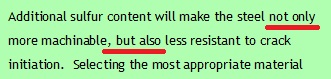
Observe the example sentence in the graphic above.  The mistake highlighted with red underline appears quite frequently.  And there are actually three options for correcting it.

The main problem lies with the comma.  The writer has placed the comma, a punctuation mark indicating structure by distinguishing different parts of the sentence, in the midst of a correlative conjunction pair which indicates structure by joining or connecting.  In other words, the comma is a wedge splitting a joint.

The writer very likely introduced that wedge by failing to recognize the distinctions between spoken and written English.  When speaking aloud words appearing in written English, people generally introduce a pause when encountering a comma.  However, that does not mean that a pause in spoken English will always translate into a comma in written English.  It doesn’t.

The writer has three options for correction.  First, the writer may choose to omit the comma.  The pair of correlative conjunctions is not only and but also.  A comma placed between them is a wedge splitting apart the joint created by using each part of the correlative conjunction air.  Removing the comma removes the wedge and “solidifies” the joint.  Using this option, the sentence becomes


Additional sulfur content will make the steel not only more machinable but also less resistant to crack initiation.

Alternatively, the writer may replace only with another word or phrase that serves the same function, such as as well, for instance.  Note once more the absence of the comma.

Additional sulfur content will make the steel not only more machinable but less resistant to crack initiation as well, including abandoning the use of the correlative conjunction pair.

Finally, the writer may elect to keep the comma.  Taking this option often means making some adjustments to the sentence.

Additional sulfur content make the steel more machinable, but it will make it also less resistant to crack initiation.

Keeping the comma before the coordinating conjunction but indicates a division between a complete sentence before the comma and a complete sentence after but.  This is another reason why using a comma before but also when paired with not only is improper.

All else being equal, each of these options for correction is equally appropriate.  The writer’s discretion can decide which option prevails.

However, when using correlative conjunction pairs, don’t let the common error of using an inappropriate comma prevail upon you.  Skip the comma with correlative conjunction pairs, and make your writing more effective.
0 Comments

Tip #42: Infer to conclude, but imply to hint or suggest

11/25/2014

0 Comments

 
Picture
In my last tip I addressed the slight but significant difference between differ from and differ with.  In this tip, I tackle a similar distinction between to infer and to imply.  Observe the example in the image at left.

To infer means to conclude or to draw a conclusion.  To imply means to hint or to suggest.  Thus, audiences (those receiving a message) infer while communicators (those sending out a message) imply.  Accordingly, a savvy writer will adjust the sentence in the example graphic to look more like this:


The assessment report implies that catastrophic failure was imminent, contrary to the findings of our own investigation.

In this instance, to imply is the correct verb.  A report sends out messages rather than receives them; thus, a report does not draw conclusions but can hint or suggest.  Report readers, on the other hand, can draw conclusions.  Thus,

Management inferred from the report that consultation with a lawyer might be prudent.

is an appropriate use of the verb to infer.  Report writers can also draw conclusions, so what about them?  Would the following sentence be improper?

We infer from our investigation that catastrophic failure was not imminent.

The answer is no.  This sentence is quite proper, because here the investigation plays the role of communicator (sending a message) and the report writers play the role of the audience (receiving a message).  The subject paired with the verb plays the role of audience, and thus the use of to infer as the verb is appropriate.

Remembering the roles that to infer and to imply may legitimately play based on their definitions can help steer a writer clear of imprecise writing.  To infer means to conclude, which can be done by the receiver of a message and not the sender.  To imply means to hint or to suggest, which can be done by the sender and the receiver.  Thus, just as messages are received from the sender, infer to draw conclusions, but imply to hint or suggest.
0 Comments

Tip #41: Differ with people but from inanimate objects

11/22/2014

0 Comments

 
Picture
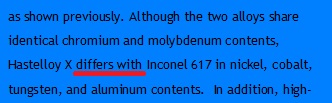
Sometimes slight nuances have great significance.  Examine, for instance, the example sentence in the image at left.  An untrained writer would likely detect no problem.  And yet a problem remains all the same.

The phrase to differ with implies disagreement.  And that is just the problem.  Metal alloys are inanimate objects, and inanimate objects can neither agree nor disagree.  The acts of agreement and disagreement are choices which only living organisms with the capacity for choice can make.  For this reason, writers use to differ with imprecisely when applying that phrase to inanimate objects.

However, inanimate objects can differ from one another in terms of characteristics.  This is the sense that the example sentence in the image above conveys.  Thus, the more appropriate expression would be as follows:


Although the two alloys share identical chromium and molybdenum contents, Hastelloy X differs from Inconel 617 in nickel, cobalt, tungsten, and aluminum contents.

Writers use differ with most appropriately when writing about people.  For example,

In terms of project utility, the team differs with the independent auditing staff.

Precision of language, especially in professional contexts, always makes for more effective writing.  And more effective writing is always better writing.  So remember that you can differ with people but from inanimate objects.
0 Comments

Tip #40: The fewer things can be counted, the less things cannot be

11/20/2014

0 Comments

 
Picture
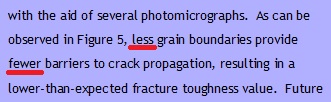
As might be expected in any language, words with similar meanings can often get confused.  Such is the case with the words fewer and less.  Note the example in the image at left.

The example sentence in the graphic is not correct, because less is used only with items that cannot be counted. Grain boundaries can be counted, and so the proper word to use is fewer.  Note that the use of the word fewer is used in the example sentence correctly, since barriers are items that can be counted.

Thus, the corrected sentence would appear as follows:


As can be observed in Figure 5, fewer grain boundaries provide fewer barriers to crack propagation, resulting in a lower-than expected fracture toughness value.

The rule is very simple.  Fewer is used with items that can be counted.  Less is used with items that cannot be counted.  For example,

The operation results in less sulfuric acid production.

The use of less here is correct.  Production cannot be counted.  Note that production can be measured and that being measured is not the same as being counted.  Units of measure can be counted, but the item being measured may or may not be countable.  Thus, changing the reference from production to something measurable (such as a unit of measure) makes the use of less incorrect.

The operation results in fewer tons per day of sulfuric acid.

Fewer is used with countable items.  Less is used with non-countable items.  Just remember that the fewer things can be counted, the less things cannot be.  Then you’re not likely to go astray.
0 Comments

Tip #39: Two words are a lot more than one

11/18/2014

0 Comments

 
Picture
Because English is a borrowed language, instances in which words sound the same but have different spellings can not only occur but also occur frequently.  And when writers confuse spoken English and written English, errors sprout.

Take, for example, the phrase a lot.  And yes, I said phrase because a lot is two words, not one.  Yet spoken English provides no distinction between one word or two words.  That's part of why understanding the distinction between written English and spoken English is so important.

Observing the example sentence in the graphic above, here is the corrected sentence:


Due to improper manufacture, a lot of the support units failed in low-cycle fatigue.

In this particular example, the writer actually has multiple options for correction.  The first appears above.  Another option replaces the phrase a lot with another word of phrase that communicates a more formal tone.  Since the context of this example sentence is likely professional, the writer should avoid an informal tone.

For example, the writer can choose a word like many.  The sentence would then read as follows:

Due to improper manufacture, many of the support units failed in low-cycle fatigue.

Do you notice the difference?  Alternatively, the writer can specify the exact number of units that failed.  This choice would produce a sentence like one of the following:

Due to improper manufacture, seven of the support units failed in low-cycle fatigue.

Due to improper manufacture, seven of the ten support units failed in low-cycle fatigue.

None of the suggestions shown for replacing a lot is anymore right or correct than any other.  The writer can choose according to personal proclivity.

However, when using the phrase a lot, just remember that two words are a lot more than one. Then you'll get the spelling of that phrase correct if not the usage.
0 Comments

Tip #38: Always prefer to, not over

11/15/2014

0 Comments

 
Picture
Here’s a mistake that appears somewhat commonly.  It involves the use of the word prefer.  Note the sample sentence in the image at left.  As usual, the image highlights the mistake within the sentence.

Written correctly, the sentence should appear as follows:


Generally, galvanic corrosion prefers zinc to iron and iron to copper.

The use of the preposition over rather than the preposition to results from the failure to separate spoken English (in which the use of the phrase prefer over is somewhat common) from written English (in which the use of the phrase prefer over is not correct).

You can understand better why prefer to is correct and prefer over is not with a little thought.  Suppose that you had a choice between two physical objects, each of which has been placed before you.  You indicate your preference with the common hand gesture of pointing.

Now, here is the key question: Do you point to your choice?  Or do you point over your choice?  Clearly, you point to your choice.  And that’s why prefer to is correct in written English and prefer over is not.  When you think about the functionality of the words, prefer over just doesn’t make any sense.

So always remember to prefer to, not over.  Then you can prefer more effective writing to less effective writing.
0 Comments

Tip #37: Always credit with having, not as having

11/13/2014

0 Comments

 
Picture
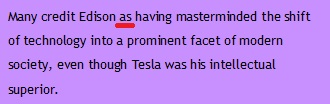
In my recent writing tips, I may have given the impression that I have a grudge with the preposition with.  Not so.  Here’s one instance in which using with is very appropriate.

Examine the sample sentence in the graphic at left.  The sentence really should appear as shown below.  Credit with having is always used, not credit as having.


Many credit Edison with having masterminded the shift of technology into a prominent facet of modern society, even though Tesla was his intellectual superior.

Again, we see yet another instance of the failure to separate spoken English from written English.  The phrase credit as having is quite common in spoken English.  But in written English this phrase loses any sense of appropriateness.  Credit with having is the proper expression.

This rule makes lots of sense when you think about it.  What does it mean to credit?  In the context of the phrase in question, credit means a commendation or honor bestowed for some action or quality.  The preposition as simply doesn’t match that definition.  But the preposition with does.  As connotes a connection of similarity.  With connotes a connection of equality, if not in substance than certainly in position.

So always credit with having, not as having.  Then you can credit yourself with having one more grammar rule conquered and being a better writer (if only a little bit).
0 Comments

Tip #36: Always contrast to, never with

11/11/2014

0 Comments

 
Picture
In my last tip, I denounced the use of the phrase in comparison with in favor of the phrase in comparison to.  Today, we're looking at the flip side of the coin.  And the rule is exactly the same.

When making contrasts, always use the preposition to and not the preposition with.  Examine the sample sentence in the graphic.  It really should appear as shown below.


In contrast to 17-4 PH stainless steel, duplex stainless steel is not heat-treatable.

What’s the difference between a comparison and a contrast?  Typically, comparison refers to similarity while contrast refers too difference. Yet in the evolution of the English language, comparison has come to connote the juxtaposition of two items or ideas, thus including difference as well similarity between the items or ideas.

The bottom line is when using in contrast (or in comparison), always use in contrast to (or in comparison to) and never in contrast with (or in comparison with).  Clearer writing always makes for better writing.
0 Comments

Tip #35: Always make comparison to, not with

11/8/2014

0 Comments

 
Picture
In my last tip, I demonstrated the difference between compare to and compare with.  Either phrase could be correct, depending on the intention to focus on similarity (compare to) or difference (compare with).

However, when you make comparison, you should always use the preposition to.  Make comparison with is never correct.  Thus, the writer should change the sample sentence in the image to the following:


In comparison to 17-4 PH stainless steel, Type 410 stainless steel is heat-treatable.

Why is with unacceptable here whereas before it was acceptable?  I’m not certain why.  Looking back to my tip regarding the use of compare to and compare with, the word compare there is used in the verb form.  For the sample above, the related cousin word comparison is used here in the noun form.  Why should that make a difference?

Again, I’m not entirely certain.  Language is constantly evolving.  And especially with a borrowed language like English, sometimes a word usage can evolve in one direction or at a one rate while the same or similar word in a different usage can evolve in a different direction or at a different rate.

I am certain, however, that respecting important distinctions, however they came to be, makes for clearer writing. And clearer writing always makes for better writing.
0 Comments

Tip #34: Always compare to similarities and with differences

11/6/2014

0 Comments

 
Picture
I’ve said it before.  And I’ll say it again because it never gets old.  Many of the difficulties we encounter in writing stem from failing to separate written English from spoken English.  They are two different animals.

Here’s yet another common manifestation of that reality.  Note the sample text in the image at right.  Let's take a look at the first sentence in the image.


The material selection report compares Type 410 to Type 416 for use in exhaust manifolds.

Type 410 and Type 416 are both martensitic stainless steels.  Both materials have high strength and can be hardened by heat treatment.  The sample sentence uses these two materials as the objects of a comparison.  Because of the similarity in the objects of the comparison, the preposition to is used in the sample sentence.

But one important difference exists between Types 410 and 416 stainless steel.  Type 410 is a general martensitic stainless steel; other martensitic stainless steels are just modifications of Type 410.  Type 416 is no exception; it contains extra phosphorus and sulfur to improve machinability.  So if the author wanted to focus on the difference, he or she would use the preposition with.

The material selection report compares Type 410 with Type 416 for use in exhaust manifolds.

Many English speakers make no distinction between compare to and compare with.  Yet that’s not really the case.  Compare to is used to highlight similarities, whereas compare with is used to highlight differences.  

That’s a very significant distinction.  And respecting that distinction makes for clearer writing, which always makes for better writing.
0 Comments
<<Previous
    Picture

    Author

    Howdy!  I'm Lance, Managing Editor of words by kurt.  I'm also an engineer and an educator.  With degrees in both engineering and English, I've been providing writing-related services since 1997, and I want to help my fellow engineers become better writers.  That's why in 2014 I started providing free writing tips via this blog.  Enjoy!

    Archives

    January 2020
    December 2019
    November 2019
    October 2019
    September 2019
    August 2019
    July 2019
    June 2019
    May 2019
    April 2019
    March 2019
    February 2019
    January 2019
    December 2018
    November 2018
    October 2018
    September 2018
    August 2018
    July 2018
    June 2018
    May 2018
    April 2018
    March 2018
    February 2018
    January 2018
    December 2017
    November 2017
    October 2017
    September 2017
    August 2017
    July 2017
    June 2017
    May 2017
    April 2017
    March 2017
    February 2017
    January 2017
    December 2016
    November 2016
    October 2016
    September 2016
    August 2016
    July 2016
    June 2016
    May 2016
    April 2016
    March 2016
    February 2016
    January 2016
    December 2015
    November 2015
    October 2015
    September 2015
    August 2015
    July 2015
    June 2015
    May 2015
    April 2015
    March 2015
    February 2015
    January 2015
    December 2014
    November 2014
    October 2014
    September 2014
    July 2014
    June 2014
    May 2014
    April 2014
    March 2014
    February 2014
    January 2014

    Categories

    All
    Abbreviations
    Accumulative Vs Cumulative
    Acronyms
    Activate Vs Actuate
    Active Voice
    Active Voice Vs. Passive Voice
    Adapt Vs Adept Vs Adopt
    Ad Hoc
    Adjectives
    Adverbs
    Affect
    Affect Vs Effect
    Affinity
    Aforesaid
    Agree In Number
    All Around / All-around / All-round
    All Ready Vs Already
    All Together Vs Altogether
    Allude Vs Elude Vs Refer
    Allusion Vs Illusion
    Almost Vs Most
    A Lot
    Also
    Apostrophe
    As Per
    As Such
    Assure Vs Ensure Vs Insure
    As To
    As To Whether
    As Well As Vs Both
    Attribute
    Audience
    Average
    A While Vs Awhile
    Bad /badly
    Balance Vs Remainder
    Because
    Because Of
    Between You And Me
    Bi-/semi-
    Both ... And
    Both Vs As Well As
    Brevity
    Bunch
    Cannot Help But
    Can Vs May
    Capitalization
    Capital Vs Capitol
    Clarity And Conciseness
    Colon
    Commas
    Committee
    Compare To/with
    Compose Vs Comprise
    Conjunctions
    Connotation
    Consensus
    Context
    Continual Vs Continuous
    Contribute
    Credible Vs Creditable
    Credit As/with
    Criterion / Criteria / Criterions
    Cumulative Vs Accumulative
    Dash
    Dates
    Datum Vs Data
    Decided Vs Decisive
    Defective Vs Deficient
    Definite Vs Definitive
    Denotation
    Despite
    Despite / Despite Of
    Distinguish From
    Do It/so
    Due To
    Each Other
    Each Other Vs One Another
    Economic Vs Economical
    Effect
    Either/or
    Elude Vs Allude Vs Refer
    Ensure Vs Insure
    Euphemisms
    Everybody Vs Everyone
    Farther Vs Further
    Few
    Figuratively Vs Literally
    Fine
    Flammable
    Foreign Words
    Good Vs Well
    Half
    Hyphens
    If And When
    If Vs. Whether
    Illegal Vs Illicit
    Illusion Vs Allusion
    Inasmuch-as
    In Comparison To/with
    In-contrast-towith
    Incredible Vs Incredulous
    Infinitive Verbs
    Inflammable
    Initialisms
    In Order To
    Inside (of)
    Insofar As
    Insoluble Vs Unsolvable
    In Spite Of
    Intensifiers
    In-terms-of
    Its Vs. It's
    Lay Vs. Lie
    Lend/loan
    Liable
    Libel
    -like
    Likely
    Lists
    Literally Vs Figuratively
    Long Variants
    Loose Vs Lose
    May Be Vs Maybe
    May Vs Can
    More/less Than
    Most Vs Almost
    Mr. Morton
    MS (MSS)
    Neither/nor
    Neo-
    Nice
    Nominalization
    Nonflammable
    Notable Vs Noticeable
    Not And
    Nouns
    Number Vs.amount
    Observance Vs Observation
    Of Which Vs Whose
    Okay / OK / O.K.
    On Account Of
    One Another
    Only
    On The Grounds Of/that
    Oral
    Outside (of)
    Parallel Structure
    Party
    Passed Vs Past
    Passive Voice
    People Vs Persons
    Per
    Plural Possessive Nouns
    Possessive Nouns
    Precision In Writing
    Predicate
    Pronoun Antecedent Agreement
    Pronouns
    Proved Vs Proven
    Quid Pro Quo
    Quite
    Rather
    Redundant Words
    Refer Vs Allude Vs Elude
    Remainder
    Respective/respectively
    Schoolhouse Rock
    Semi-/bi-
    Semicolon
    Shall Vs Will
    Singular Possessive Nouns
    -size / -sized
    So
    Some
    Some Vs Somewhat
    So That Vs Such That
    Split Infinitives
    Spoken English Vs Written English
    Strata Vs Stratum
    Subject
    Subject Verb Agreement
    Subject-verb Agreement
    Such
    Such That Vs So That
    Tenant Vs Tenet
    Tenet Vs Tenant
    Than Vs. Then
    That Vs Where
    The Fact Is
    Too
    To Vs Too Vs Two
    Try And/to
    Unsolvable Ve Insoluble
    Verbal
    Verbs
    Very
    Waiting For/on
    Well Vs Good
    When And If
    Where . . . At
    Where Vs That
    Whether Or Not
    While
    Whose Vs Of Which
    Who's Vs Whose
    Who Vs. Whom
    Will Vs Shall
    -wise
    Wordiness
    Words Used As Words

    RSS Feed

    Copyright © 2014-2015
    words by kurt
    LLC

We Would Love to Help You Become a Better Writer!


Tech Writing

Accepting new jobs now!

Nonfiction

Accepting new jobs now!

Family History

Accepting new jobs now!

Consulting

Accepting new jobs now!