
words by kurt
  • Home
  • Core Clients
    • Engineers & Scientists
    • Nonfiction Authors
    • Family Historians
    • Consulting
  • Quotes & Pricing
  • Resources
  • Writing Tips
  • Contact
Improving writing one writer at a time

Tip #16: Dash to use the dash when appropriate

4/17/2014

0 Comments

 
Picture
Written English offers an array of punctuation.  Experienced writers know how to navigate these choices much like a painter selects colors from a palette.

One such “color” is the dash, represented in typeset with three hyphens.  Many word processing programs will automatically join these lines together into a single line — the dash.

Did you see how I used the dash just now?  Writers usually use the dash where another punctuation mark, usually a comma, is employed.  The replacement of another suitable punctuation mark creates a special emphasis to the phrase set apart by dashes.  When not replacing another punctuation mark, dashes usually indicate an abrupt side note in the main idea of the sentence.

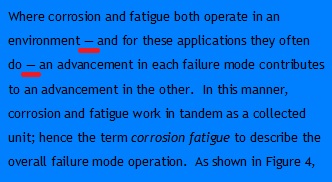
Consider the example in the graphic above, which demonstrates an appropriate and effective use of the dash.  Observe the effect imparted by the dash.  In this example, the dashes could replace commas.


Where corrosion and fatigue both operate in an environment, and for these applications they often do, an advancement in each failure mode contributes to an advancement in the other.

Or they could replace parentheses.

Where corrosion and fatigue both operate in an environment (and for these applications they often do) an advancement in each failure mode contributes to an advancement in the other.

Each of these example sentences is grammatically correct.  But the dash imparts a greater sense of emphasis and interruption than either commas or parentheses.

Note the use of spaces before and after the dash.  Writers can use or not use these spaces according to their preference.  Thus, it would be just as correct to write

Where corrosion and fatigue both operate in an environment—and for these applications they often do—an advancement in each failure mode contributes to an advancement in the other.

However, I recommend using the spaces.  Writers use the dash primarily to generate emphasis of an idea connected with or related to the main idea in a sentence.  The spaces before and after each dash reinforce that sense of emphasis while communicating that the idea offset with the dash is connected but separate.

Of course, overuse of the dash will blunt its edge for providing emphasis.  Thus, experienced writers will use the dash sparingly.  But do dash to use the dash when appropriate.  It can provide some visual spice for your readers while emphasizing important side notes.
0 Comments
    Picture

    Author

    Howdy!  I'm Lance, Managing Editor of words by kurt.  I'm also an engineer and an educator.  With degrees in both engineering and English, I've been providing writing-related services since 1997, and I want to help my fellow engineers become better writers.  That's why in 2014 I started providing free writing tips via this blog.  Enjoy!

    Archives

    January 2020
    December 2019
    November 2019
    October 2019
    September 2019
    August 2019
    July 2019
    June 2019
    May 2019
    April 2019
    March 2019
    February 2019
    January 2019
    December 2018
    November 2018
    October 2018
    September 2018
    August 2018
    July 2018
    June 2018
    May 2018
    April 2018
    March 2018
    February 2018
    January 2018
    December 2017
    November 2017
    October 2017
    September 2017
    August 2017
    July 2017
    June 2017
    May 2017
    April 2017
    March 2017
    February 2017
    January 2017
    December 2016
    November 2016
    October 2016
    September 2016
    August 2016
    July 2016
    June 2016
    May 2016
    April 2016
    March 2016
    February 2016
    January 2016
    December 2015
    November 2015
    October 2015
    September 2015
    August 2015
    July 2015
    June 2015
    May 2015
    April 2015
    March 2015
    February 2015
    January 2015
    December 2014
    November 2014
    October 2014
    September 2014
    July 2014
    June 2014
    May 2014
    April 2014
    March 2014
    February 2014
    January 2014

    Categories

    All
    Abbreviations
    Accumulative Vs Cumulative
    Acronyms
    Activate Vs Actuate
    Active Voice
    Active Voice Vs. Passive Voice
    Adapt Vs Adept Vs Adopt
    Ad Hoc
    Adjectives
    Adverbs
    Affect
    Affect Vs Effect
    Affinity
    Aforesaid
    Agree In Number
    All Around / All-around / All-round
    All Ready Vs Already
    All Together Vs Altogether
    Allude Vs Elude Vs Refer
    Allusion Vs Illusion
    Almost Vs Most
    A Lot
    Also
    Apostrophe
    As Per
    As Such
    Assure Vs Ensure Vs Insure
    As To
    As To Whether
    As Well As Vs Both
    Attribute
    Audience
    Average
    A While Vs Awhile
    Bad /badly
    Balance Vs Remainder
    Because
    Because Of
    Between You And Me
    Bi-/semi-
    Both ... And
    Both Vs As Well As
    Brevity
    Bunch
    Cannot Help But
    Can Vs May
    Capitalization
    Capital Vs Capitol
    Clarity And Conciseness
    Colon
    Commas
    Committee
    Compare To/with
    Compose Vs Comprise
    Conjunctions
    Connotation
    Consensus
    Context
    Continual Vs Continuous
    Contribute
    Credible Vs Creditable
    Credit As/with
    Criterion / Criteria / Criterions
    Cumulative Vs Accumulative
    Dash
    Dates
    Datum Vs Data
    Decided Vs Decisive
    Defective Vs Deficient
    Definite Vs Definitive
    Denotation
    Despite
    Despite / Despite Of
    Distinguish From
    Do It/so
    Due To
    Each Other
    Each Other Vs One Another
    Economic Vs Economical
    Effect
    Either/or
    Elude Vs Allude Vs Refer
    Ensure Vs Insure
    Euphemisms
    Everybody Vs Everyone
    Farther Vs Further
    Few
    Figuratively Vs Literally
    Fine
    Flammable
    Foreign Words
    Good Vs Well
    Half
    Hyphens
    If And When
    If Vs. Whether
    Illegal Vs Illicit
    Illusion Vs Allusion
    Inasmuch-as
    In Comparison To/with
    In-contrast-towith
    Incredible Vs Incredulous
    Infinitive Verbs
    Inflammable
    Initialisms
    In Order To
    Inside (of)
    Insofar As
    Insoluble Vs Unsolvable
    In Spite Of
    Intensifiers
    In-terms-of
    Its Vs. It's
    Lay Vs. Lie
    Lend/loan
    Liable
    Libel
    -like
    Likely
    Lists
    Literally Vs Figuratively
    Long Variants
    Loose Vs Lose
    May Be Vs Maybe
    May Vs Can
    More/less Than
    Most Vs Almost
    Mr. Morton
    MS (MSS)
    Neither/nor
    Neo-
    Nice
    Nominalization
    Nonflammable
    Notable Vs Noticeable
    Not And
    Nouns
    Number Vs.amount
    Observance Vs Observation
    Of Which Vs Whose
    Okay / OK / O.K.
    On Account Of
    One Another
    Only
    On The Grounds Of/that
    Oral
    Outside (of)
    Parallel Structure
    Party
    Passed Vs Past
    Passive Voice
    People Vs Persons
    Per
    Plural Possessive Nouns
    Possessive Nouns
    Precision In Writing
    Predicate
    Pronoun Antecedent Agreement
    Pronouns
    Proved Vs Proven
    Quid Pro Quo
    Quite
    Rather
    Redundant Words
    Refer Vs Allude Vs Elude
    Remainder
    Respective/respectively
    Schoolhouse Rock
    Semi-/bi-
    Semicolon
    Shall Vs Will
    Singular Possessive Nouns
    -size / -sized
    So
    Some
    Some Vs Somewhat
    So That Vs Such That
    Split Infinitives
    Spoken English Vs Written English
    Strata Vs Stratum
    Subject
    Subject Verb Agreement
    Subject-verb Agreement
    Such
    Such That Vs So That
    Tenant Vs Tenet
    Tenet Vs Tenant
    Than Vs. Then
    That Vs Where
    The Fact Is
    Too
    To Vs Too Vs Two
    Try And/to
    Unsolvable Ve Insoluble
    Verbal
    Verbs
    Very
    Waiting For/on
    Well Vs Good
    When And If
    Where . . . At
    Where Vs That
    Whether Or Not
    While
    Whose Vs Of Which
    Who's Vs Whose
    Who Vs. Whom
    Will Vs Shall
    -wise
    Wordiness
    Words Used As Words

    RSS Feed

    Copyright © 2014-2015
    words by kurt
    LLC

We Would Love to Help You Become a Better Writer!


Tech Writing

Accepting new jobs now!

Nonfiction

Accepting new jobs now!

Family History

Accepting new jobs now!

Consulting

Accepting new jobs now!